
If you manage a registered organization, annual compliance is not just paperwork. It is a set of time bound responsibilities under the Fair Work Registered Organizations Act 2009 (ROA Act). And while financial reporting and annual returns may sound straightforward in principle, the reality is that financial year end dates differ across registered organizations because each organization selects its own financial year.
That is why the Fair Work Commission provides practical tools to help organizations work out exactly when obligations are due, including the timelines tied to ROA Act lodgements. In particular, if you are thinking about Regulated Worker; Last Mile; Transport Safety related governance and oversight, reliable compliance timing supports consistent reporting and reduces risk across internal processes.
Table of Contents
- 📅 Why compliance timelines matter for registered organizations
- 🧭 The Fair Work Commission compliance calculator
- 🛠️ How to use the calculator step by step
- 🧾 Example: a statement provided to members before lodging
- 📌 Building a compliance schedule that actually works
- 🔍 What comes next in a deeper compliance series
- ❓ FAQ
📅 Why compliance timelines matter for registered organizations
Registered organizations have important obligations each year. These typically include things like:
- financial reporting
- annual returns
- other statutory lodgements
The hard part is not necessarily knowing the obligations exist. It is knowing when they are due for your specific organization. The ROA Act framework interacts with your chosen financial year, so two organizations can have different timeframes even if they are both complying with the same general requirements.

🧭 The Fair Work Commission compliance calculator
One of the most useful resources provided by the Fair Work Commission is its online compliance calculator. This tool is designed to help registered organizations calculate the exact due dates for fulfilling obligations.
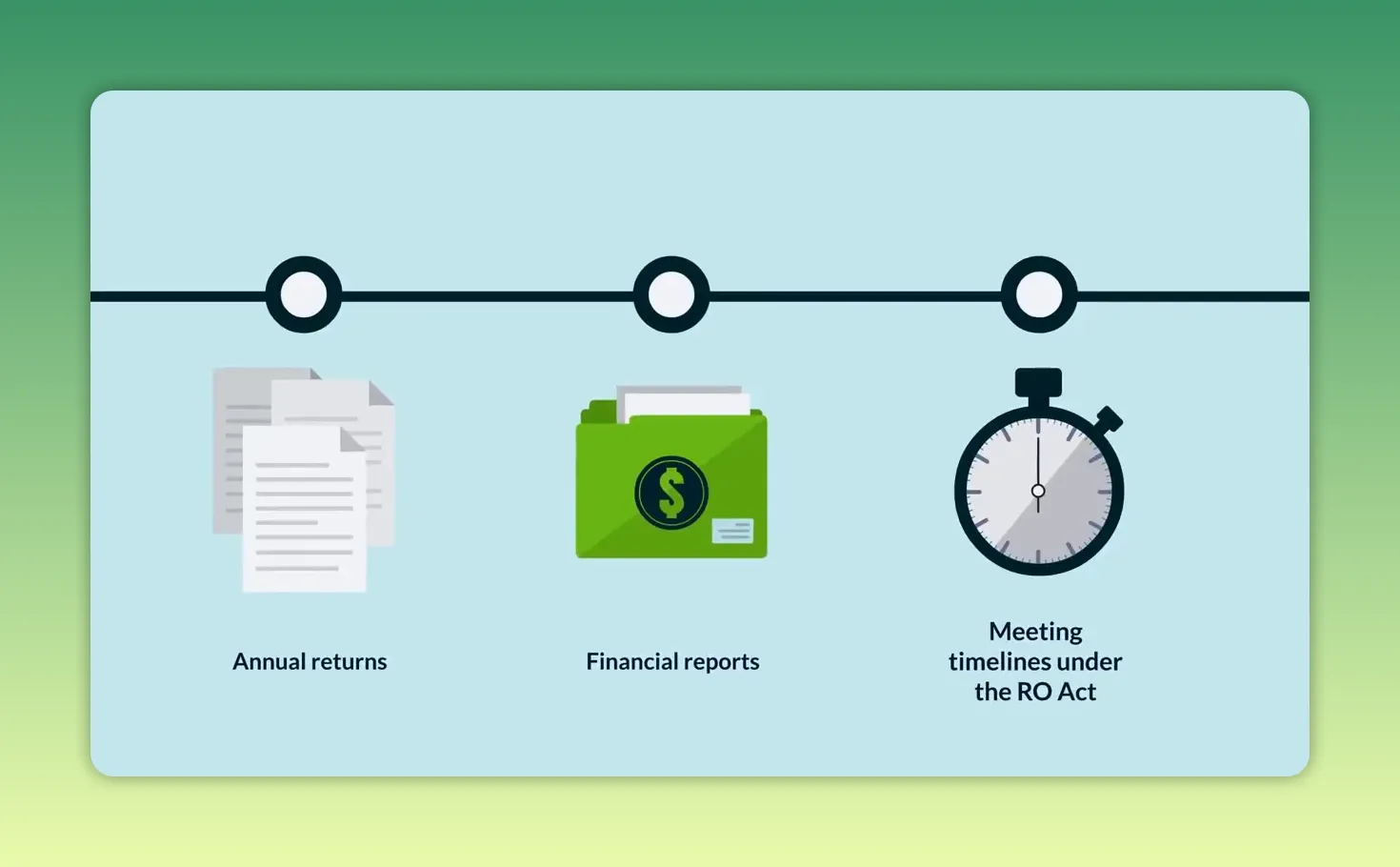
When you use the calculator, you are not just getting a single date. You are getting the time frame tied to specific obligations under the ROA Act, including:
- lodging annual returns
- presenting financial reports
- meeting the timeline requirements set out under the ROA Act
🛠️ How to use the calculator step by step
The compliance calculator is built to be quick to use, while still guiding you through the inputs that matter most.
-
Enter your financial year end date
Use the drop down list to select the financial year end date that applies to your organization. -
Select the relevant matter type
Choose the category of obligation you want the timeline for. -
Review the required time frame
The calculator shows the time frame for when the relevant statement (or document) must be provided to members. -
Plan ahead using the date entry box
You can enter a date in advance. The calculator then checks whether that date meets the required timeline. -
Respond to alerts with guidance
If your entered date does not meet the timeline, the calculator will alert you. You can use the drop down arrow in the top right corner to access an explanation of the requirements and direction to help resources.
🧾 Example: a statement provided to members before lodging
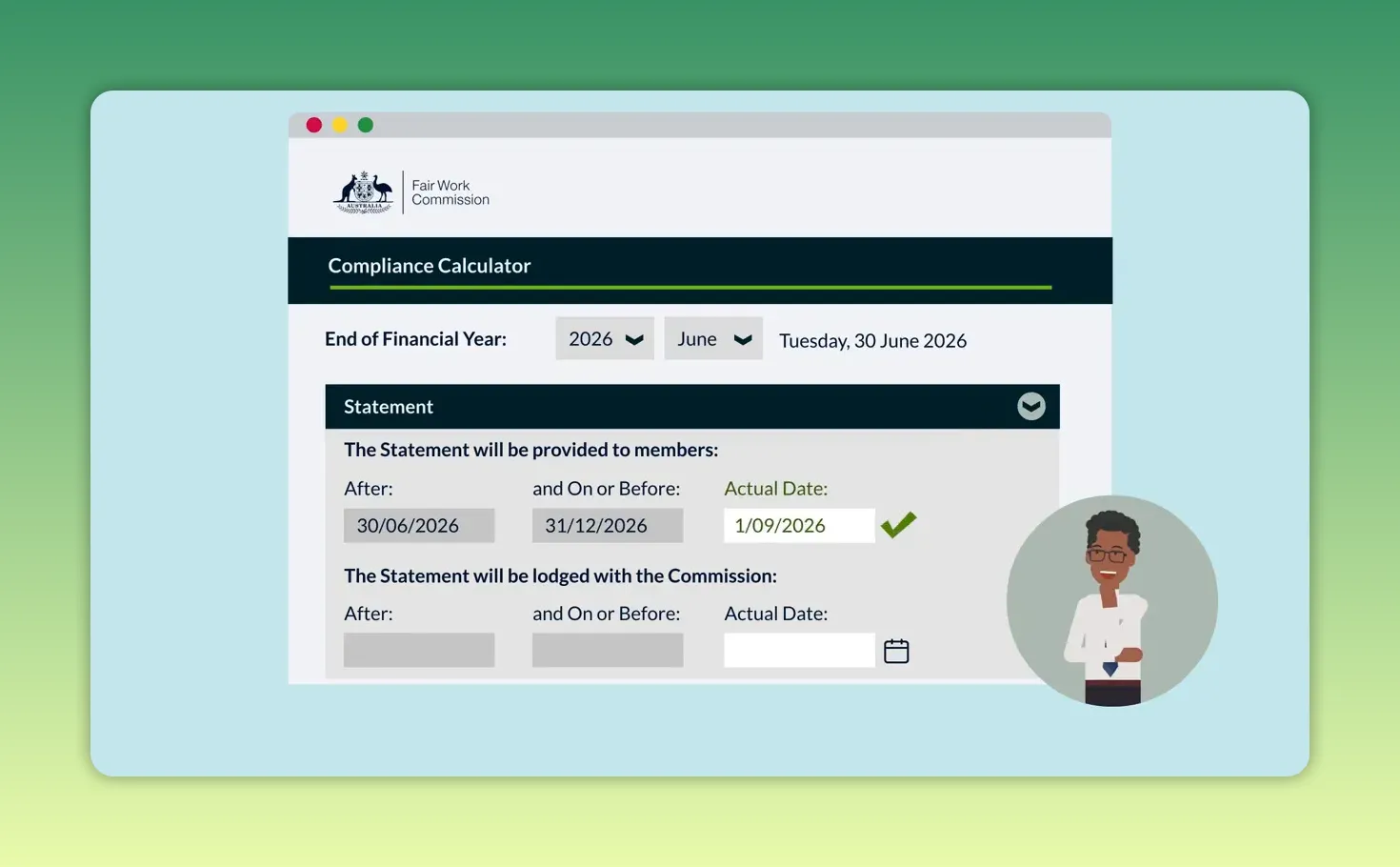
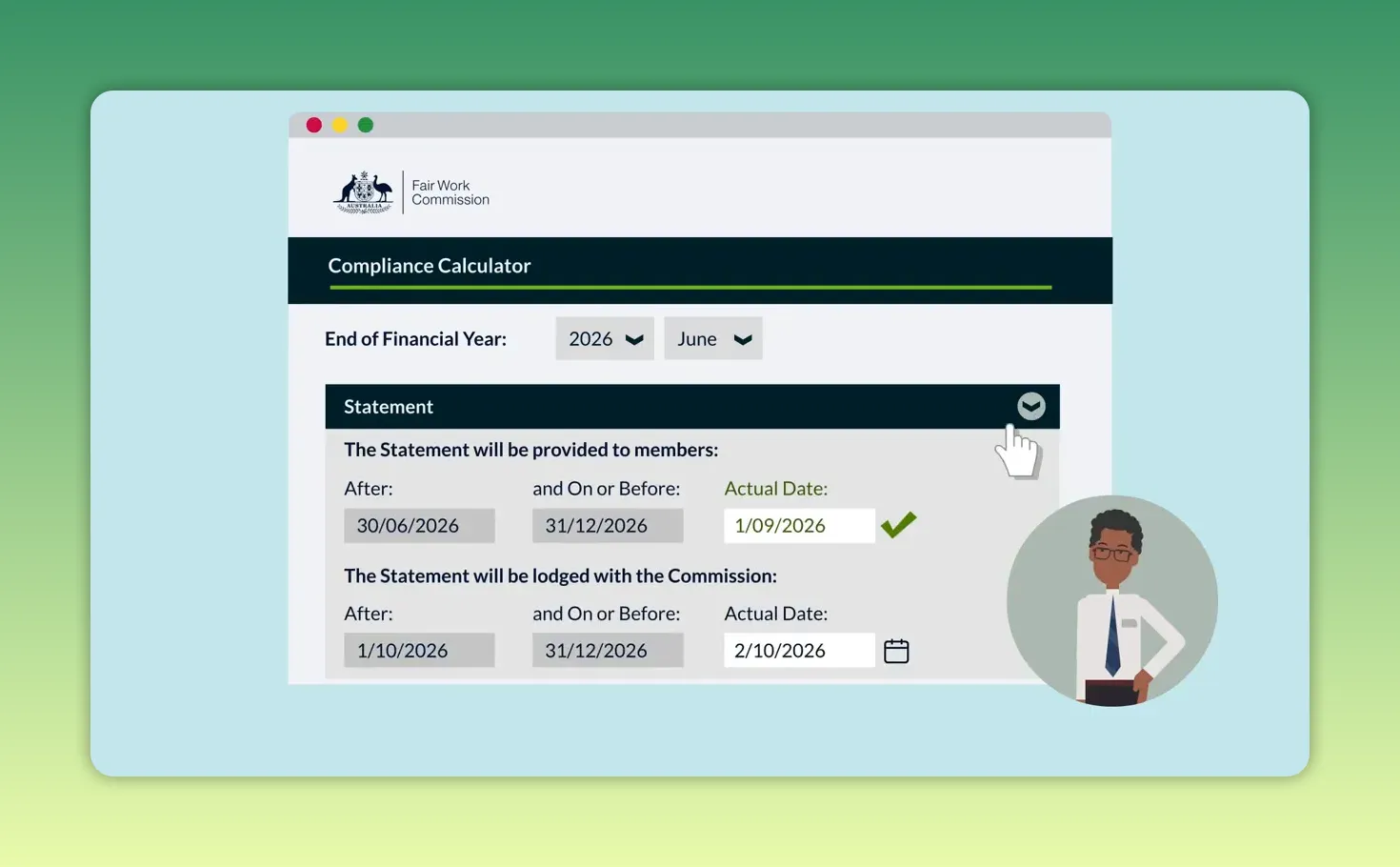
To illustrate how the timeline check works, consider the calculator output for a hypothetical matter referred to as statement.
In this example, the statement must be provided to members at least one month prior to lodging with the Commission.
That is the practical value of the calculator. Instead of working backwards manually from lodgement deadlines, you can test planning dates directly. If a chosen date falls too close to lodgement, the calculator flags it so you can adjust early.
📌 Building a compliance schedule that actually works
Keeping track of all ROA Act dates can feel challenging, especially because financial year end dates differ across organizations. A practical approach is to treat compliance like a workflow with internal checkpoints, not a single due date.
Using the compliance calculator as a starting point, you can structure your internal planning around:
- the member provision timeframes the calculator identifies
- the lodgement timeline for the relevant obligation
- any early adjustments you need if your planning date triggers an alert
Over time, this reduces last minute scrambling and makes it easier to coordinate preparation of financial reporting and annual returns with the rest of your organization’s annual cycle.
🔍 What comes next in a deeper compliance series
This first overview focuses on helping organizations understand the annual obligations and introduces the compliance calculator as the tool to calculate timelines. Additional detailed episodes in the series explore each compliance obligation under the ROA Act so organizations know what to do, when to do it, and how to meet their obligations.
If you want the official tool, you can find it at:
https://regorgs.fwc.gov.au/tools-and-resources/compliance-calculator
❓ FAQ
Why do compliance timelines vary between registered organizations?
Because financial year end dates differ across registered organizations since each organization selects its own financial year. The ROA Act timelines then apply based on those financial year parameters, so due dates can differ between organizations.
What obligations does the compliance calculator help with?
It helps calculate due dates and timeframes for obligations such as lodging annual returns, presenting financial reports, and meeting the timeline requirements under the ROA Act.
How does the calculator check whether my planned date is acceptable?
You enter a date in advance using the date box. The calculator then tells you whether your entered date meets the required timeline. If it does not, you receive an alert and can access an explanation and direction to help resources.
Can I use the calculator to plan member-related timing?
Yes. The calculator displays the time frame that a statement must be provided to members, and it can be used to test whether your planning date meets the requirement (for example, at least one month prior to lodging in the illustrative example provided).
Where can I find the compliance calculator?
On the Fair Work Commission website at https://regorgs.fwc.gov.au/tools-and-resources/compliance-calculator.
Related transport compliance resource
If your ROA Act governance also intersects with transport safety responsibilities (for example, how workplace roles, scheduling, and oversight connect to driver and freight risks), you may find the Chain of Responsibility practical guide useful. It’s designed for transport managers and operational leaders who need clear, implementable steps, templates, and checklists to identify and control CoR risks aligned with Australian regulatory expectations.
2026 Chain of Responsibility Guide Book |
|
It's a manual that protects you and your business! |
| Click me to find out more |
This article was created from the Fair Work Commission YouTube Page - Give them a Follow!


