The Fair Work Commission is evolving to better serve the modern workforce, especially as new legislation brings significant changes to how independent contractors are regulated. In this article, we explore the newly conferred functions of the Fair Work Commission concerning regulated workers, including those in the gig economy and road transport industry. This overview is designed to provide clarity on the upcoming minimum standards orders and the role the Commission will play in ensuring fair work practices under these new laws.
Table of Contents
- Introduction to the Expanded Role of the Fair Work Commission
- Who Are Regulated Workers?
- New Minimum Standards Orders and Guidelines
- Specific Considerations for the Road Transport Industry
- What Can Be Included in Minimum Standards Orders?
- How to Stay Informed and Get Involved
- Conclusion
- Frequently Asked Questions (FAQ)
Introduction to the Expanded Role of the Fair Work Commission
Justice Hatcher, President of the Fair Work Commission, highlights that over the past eighteen months, the Commission’s functions have expanded significantly through legislative amendments. These new functions focus primarily on independent contractors, specifically those who are employee-like workers engaged in digital platform work and contractors operating within the road transport sector. These amendments are set to commence on August 26, 2024, or on an earlier date if proclaimed.
Given the importance of these changes for workers and workplaces alike, the Commission is undertaking extensive consultations with affected community members and stakeholder groups. The aim is to implement these new functions transparently and with a strong focus on user needs.
Who Are Regulated Workers?
The new laws classify two main types of regulated workers:
- Employee-like workers — independent contractors working on digital platforms who exhibit characteristics such as low bargaining power, remuneration comparable to employees, and limited authority over their work.
- Regulated road transport contractors — independent contractors engaged in the road transport industry who are not categorized as employee-like workers.
Both groups share key characteristics:
- They enter into a services contract either as individuals or through various business structures, but not as principals.
- The contract must have a constitutional connection, typically meaning one party is a company.
- They perform all or the majority of their work under this contract and do not work as employees under it.
Employee-like workers must meet at least two conditions such as low bargaining power or receiving remuneration at or below employee rates for similar work. Meanwhile, regulated road transport contractors are those operating in the transport sector but do not meet the employee-like worker criteria. There is also a subcategory called road transport employee-like workers, who are employee-like workers specifically within the road transport industry.
New Minimum Standards Orders and Guidelines
With these legislative changes, the Fair Work Commission gains the authority to set minimum standards for these regulated workers. These include:
- Employee-like minimum standards orders
- Road transport minimum standards orders
- Minimum standards guidelines — non-binding recommendations to support best practices
- Road transport contractual chain orders — to regulate subcontracting arrangements in the road transport industry
The Commission can also vary or revoke these orders or guidelines as necessary.
How Are Orders Made?
The Commission may initiate a minimum standards order either on its own or following an application from:
- Organisations representing the industrial interests of regulated workers or businesses
- Regulated businesses themselves
- The Minister
Before making an order, the Commission must consider a new minimum standards objective alongside other relevant matters. This process involves extensive consultation, including:
- Engaging genuinely with those covered by the proposed order
- Publishing a notice of intent and a draft order
- Allowing a reasonable period for written submissions on the draft
- Conducting a fresh consultation if substantial changes are made to the draft
Specific Considerations for the Road Transport Industry
Commissioner Connolly, Deputy Practice Lead for Road Transport, explains additional requirements specific to the road transport sector:
- A new road transport objective will be considered alongside the minimum standards objective when dealing with road transport matters.
- Orders related to road transport must be made by an expert panel dedicated to this industry.
- A newly established Road Transport Advisory Group will be consulted before any orders are finalized.
- There must be a minimum of 12 months (or 6 months in urgent cases) between the publication of a draft order and the commencement of the final order.
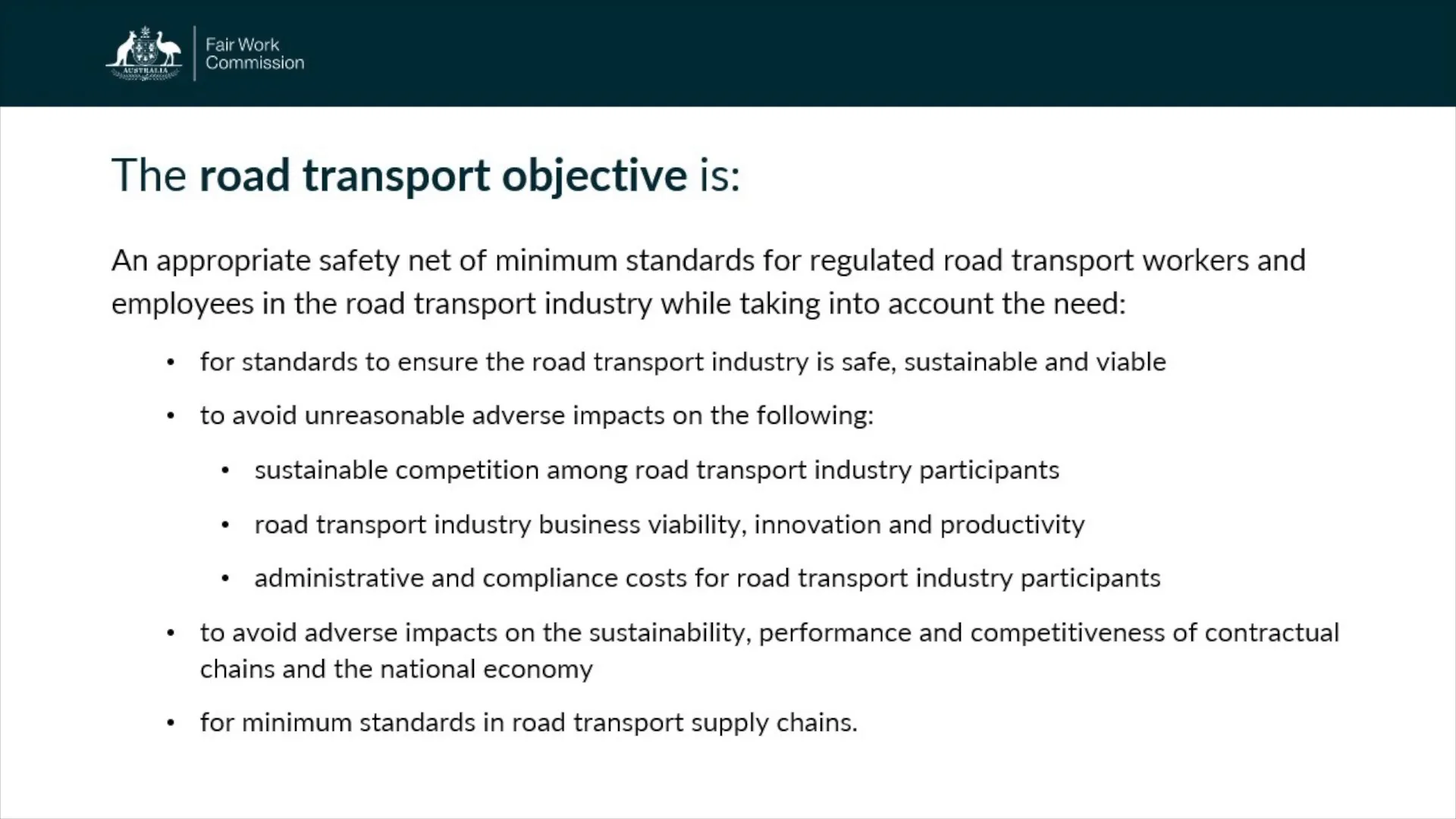
Road transport contractual chain orders address complex subcontracting arrangements that often exist between the initial contracting business and the drivers performing the work. These orders set standards for all participants in these contract chains to promote fairness and clarity.
What Can Be Included in Minimum Standards Orders?
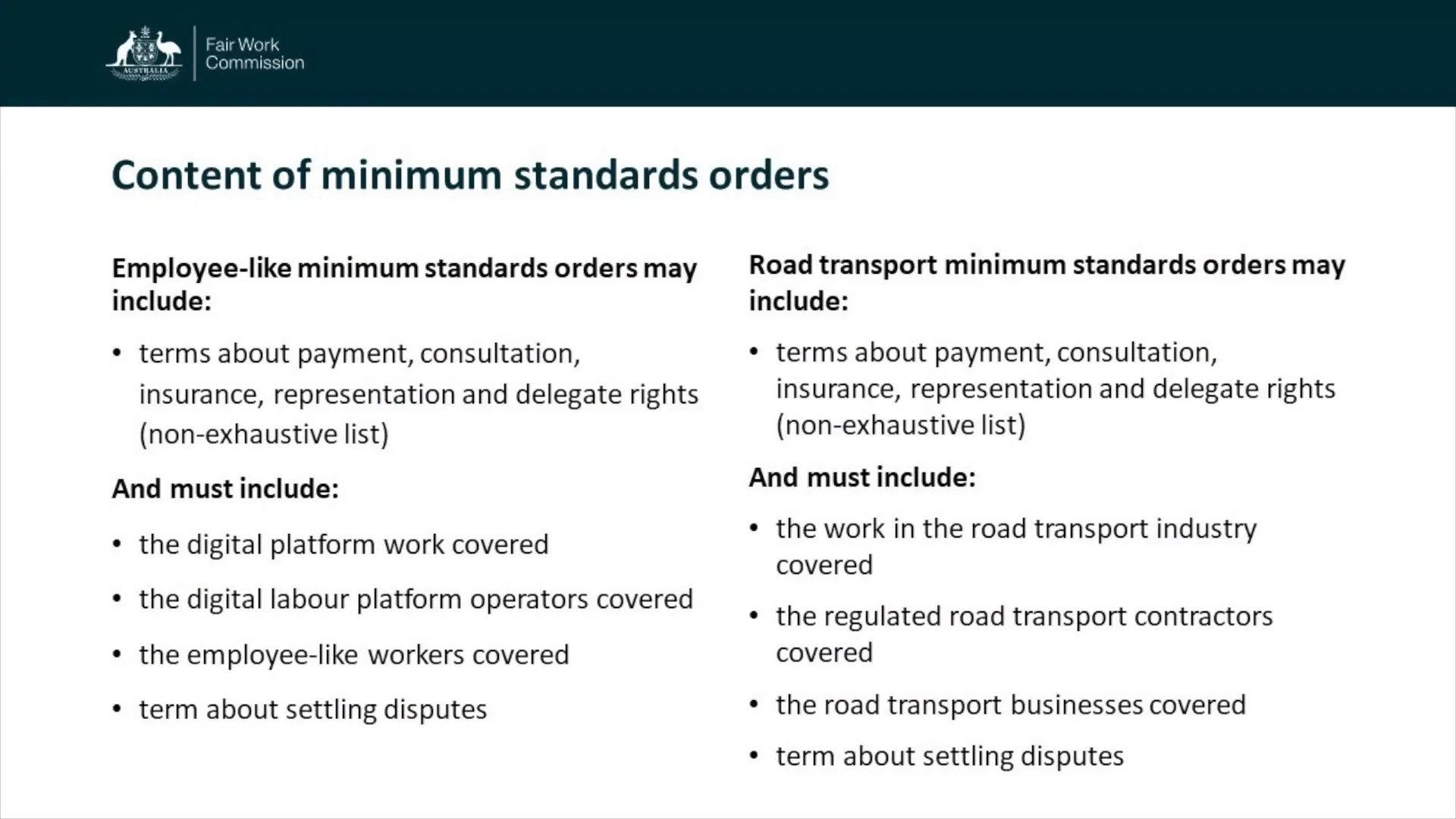
Minimum standards orders may cover terms related to:
- Payment arrangements
- Consultation processes
- Insurance requirements
- Representation and delegate rights
- Dispute resolution procedures
However, certain topics are explicitly excluded, such as:
- Overtime rates
- Rostering arrangements
- Terms that would alter the form of engagement of the regulated worker
- Work health and safety matters comprehensively covered by Commonwealth, state, or territory laws
How to Stay Informed and Get Involved
The Fair Work Commission encourages affected workers and businesses to stay informed about these new regulatory functions. Detailed information and updates are available on the Commission’s website, including opportunities to join a regulated worker user group designed to facilitate ongoing consultation and feedback.
For more detailed insights and to subscribe for updates, visit the Fair Work Commission’s regulated worker functions page.
Conclusion
The introduction of new functions for regulated workers at the Fair Work Commission marks a significant step in adapting workplace regulation to the evolving nature of work, particularly for independent contractors in the gig economy and road transport industry. By establishing clear minimum standards and fostering transparent consultation processes, the Commission aims to protect workers’ rights while supporting fair and sustainable business practices.
These changes reflect the Commission’s commitment to openness, operational excellence, and user-centered service design as it navigates this important transition.
Frequently Asked Questions (FAQ)
Who qualifies as a regulated worker under the new laws?
Regulated workers include employee-like workers engaged in digital platform work with specific characteristics such as low bargaining power, and regulated road transport contractors who are independent contractors in the road transport industry but not employee-like workers.
What are minimum standards orders?
Minimum standards orders set legally binding baseline conditions for regulated workers concerning payment, consultation, insurance, representation, and dispute resolution, among other things.
Can the Fair Work Commission change or revoke these orders?
Yes, the Commission can vary or revoke minimum standards orders or guidelines as circumstances require.
How does the Commission consult with stakeholders before making an order?
The Commission engages in extensive consultation that includes publishing draft orders, soliciting written submissions, and conducting further consultations if substantial changes are made.
What is the role of the Road Transport Advisory Group?
This newly established body advises the Commission on matters related to road transport orders to ensure industry-specific expertise and stakeholder input inform regulatory decisions.
This article was created from the Fair Work Commission Youtube video "New functions for Regulated workers".


